











Chapter 12IMAT Biology
Viruses
Welcome to the exciting world of viruses! These tiny infectious agents may be small, but they pack a big punch. With their ability to infect and replicate within host cells, viruses have shaped the course of history and continue to be a major force in biology today.
But don't let their fearsome reputation deter you – studying viruses can be both fun and rewarding. In this textbook, you'll learn about the amazing diversity of viruses and the ways in which they interact with their hosts. You'll also discover the many ways in which viruses are used in medicine and biotechnology, from vaccines to gene therapy.
So buckle up and get ready to dive into the fascinating world of viruses. Who knows, you might even catch a virus of your own – the intellectual kind, that is!
Section 12.1
Main Characteristics of Viruses
Viruses are unique entities in the biological world, as they possess distinct characteristics that set them apart from other organisms. The following is a detailed discussion of the main characteristics of viruses that make them distinct:
- Infectious, acellular pathogens: Viruses are acellular, meaning they are not made up of cells. Instead, they consist of genetic material (DNA or RNA) surrounded by a protein coat called a capsid. Some viruses also have an outer lipid envelope. Because they lack cellular structures and cannot carry out the basic functions of life on their own, viruses are often considered to be on the borderline between living and non-living entities.
- Obligate intracellular parasites with host and cell-type specificity: Viruses are obligate intracellular parasites, which means they can only reproduce inside a host cell. They cannot replicate on their own and must hijack the host cell's machinery to reproduce. Viruses often exhibit host and cell-type specificity, meaning they can only infect specific hosts or cell types within those hosts. This specificity is due to the interactions between viral surface proteins and host cell surface receptors, which determine whether a virus can enter a cell and initiate an infection.
- DNA or RNA genome (never both): Viruses contain either DNA or RNA as their genetic material, but never both. This is a unique feature, as other cellular organisms, such as bacteria, archaea, and eukaryotes, contain DNA as their genetic material. The type of genetic material in a virus can be single-stranded or double-stranded, linear or circular, and segmented or non-segmented. The genome size of viruses varies greatly, from just a few genes to over a thousand.
- Genome is surrounded by a protein capsid and, in some cases, a phospholipid membrane studded with viral glycoproteins: The viral genome is protected by a protein coat called a capsid, which is made up of protein subunits called capsomeres. The capsid provides structural stability and helps the virus attach to and enter host cells. Some viruses, called enveloped viruses, have an additional outer lipid envelope derived from the host cell membrane. This envelope is studded with viral glycoproteins that play a crucial role in recognizing and binding to host cell receptors, facilitating viral entry into the host cell.
- Lack genes for many products needed for successful reproduction, requiring exploitation of host-cell genomes to reproduce: Viruses are dependent on their host cells for reproduction because they lack many of the essential genes and enzymes required for replication, transcription, and translation. They must, therefore, exploit the host cell's genetic machinery and resources to reproduce. This exploitation can cause damage to the host cell, often leading to its death. The viral replication process can also trigger immune responses in the host, which may contribute to the symptoms and pathology of viral infections.
These unique characteristics of viruses make them distinct from other living organisms and present challenges for the development of antiviral therapies and vaccines. Understanding the specific features of viruses is crucial for the study of viral infections and the development of effective strategies to combat them.
Section 12.2
Structure
At their most basic level, viruses are simply collections of genetic material (DNA or RNA) surrounded by a protein coat. But don't let their simplicity fool you – the intricacies of viral structure are what allow them to be so effective at infecting host cells and replicating themselves.
One important aspect of viral structure is the capsid, which is the protein coat that surrounds the viral genetic material. The capsid is made up of subunits called capsomeres, which are arranged in a specific pattern to create the overall shape of the virus. The shape of the capsid can be important for the virus's ability to enter and infect host cells.
In addition to the capsid, some viruses also have an outer envelope made of lipids. This envelope is derived from the host cell's membrane and helps the virus interact with host cells and evade the host immune system.
Virus Morphology
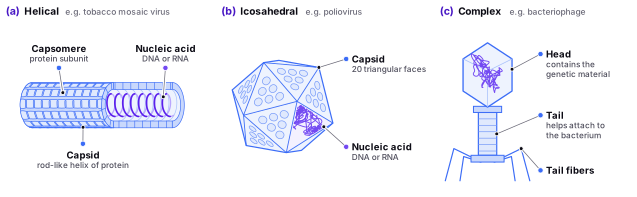
Viral morphology is the study of the shapes and structures of viruses. Viruses are tiny infectious agents that can infect all living organisms, including humans, animals, plants, and even bacteria. They are composed of genetic material (either DNA or RNA) enclosed in a protein coat called a capsid. Based on their capsid structure, viruses can be classified into three main types: helical, icosahedral, and complex. In this discussion, we will explore each of these types in detail, focusing on their structures, examples, and significances.
Helical viruses: Helical viruses have a capsid that forms a helix or spiral shape around the viral genetic material. The capsid proteins are arranged in a cylindrical manner, creating a rod-like structure. One of the most well-known examples of helical viruses is the tobacco mosaic virus (TMV), which infects plants. In humans, the influenza virus and the rabies virus also exhibit helical morphology. The helical structure provides stability and protection for the viral genetic material and facilitates entry into host cells.
Icosahedral viruses: Icosahedral viruses have a capsid structure that resembles a geometric shape called an icosahedron, which consists of 20 equilateral triangular faces. This shape is highly symmetrical and efficient in terms of enclosing the maximum volume with the minimum amount of capsid proteins. Many common human viruses, such as the adenovirus (which causes respiratory infections), the poliovirus, and the human papillomavirus (HPV), have icosahedral structures. The icosahedral shape offers stability and helps the virus to withstand harsh environmental conditions.
Complex viruses: Complex viruses have a more elaborate and intricate structure than helical or icosahedral viruses. They may possess additional components, such as tails, fibers, or envelopes, which can aid in attachment and entry into host cells. Bacteriophages, which are viruses that infect bacteria, are a prime example of complex viruses. They have a head (which can be icosahedral or helical) that contains the genetic material, and a tail that helps in attaching to the bacterial cell surface. The complex structure of these viruses allows for specialized functions, such as injecting genetic material into the host cell.
In conclusion, understanding viral morphology is essential for grasping how viruses function and interact with their hosts. Helical, icosahedral, and complex viruses exhibit distinct structures that play a crucial role in their ability to infect host cells and cause disease. By studying these structures, you will be able to gain valuable insight into the fascinating world of viruses and their interactions with living organisms.
Find it in the figure
Coming soon for figure 12.1
List of Structures
- Nucleic Acid: The genetic material of a virus is contained within its nucleic acid, which can be either DNA (deoxyribonucleic acid) or RNA (ribonucleic acid). The nucleic acid contains the instructions for viral replication, the synthesis of viral proteins, and the assembly of new virus particles. The organization of viral genomes can vary greatly, ranging from small circular molecules to complex linear structures with multiple segments.
- Capsid: The capsid is a protein coat that surrounds and protects the viral nucleic acid. It is composed of subunits called capsomeres, which are arranged in a specific pattern to create the overall shape of the virus. The shape of the capsid can be helical, icosahedral, or complex, and it can play a crucial role in the virus's ability to enter and infect host cells. The capsid also serves as an antigenic determinant, stimulating the host's immune response.
- Envelope: Some viruses have an outer envelope made of lipids that is derived from the host cell's membrane. This envelope provides additional protection and helps the virus interact with host cells by facilitating viral attachment and entry. The envelope can also play a role in the virus's ability to evade the host immune system by presenting host-derived molecules on its surface, making it harder for the immune system to recognize the virus as foreign.
- Spike proteins and other surface glycoproteins: Some viruses, such as the coronavirus that causes COVID-19, have spike proteins on their surface. These proteins help the virus bind to and enter host cells by interacting with specific host cell receptors. Other surface glycoproteins, such as hemagglutinin and neuraminidase in influenza viruses, also play critical roles in virus attachment, entry, and release from host cells.
- Replication machinery: Most viruses encode a set of enzymes and other proteins that are necessary for viral replication. These may include polymerases (which replicate the viral nucleic acid), proteases (which cleave viral proteins into functional pieces), and other enzymes that help the virus replicate, modify host cell machinery, and assemble new viruses. These viral proteins can be attractive targets for antiviral drug development.
- Host range and tissue tropism: The host range of a virus refers to the range of organisms or cell types that it can infect. Some viruses are capable of infecting a wide range of hosts, while others are highly specialized and can only infect specific types of cells or organisms. The host range is determined by the interaction between viral surface proteins and host cell receptors, as well as the ability of the virus to exploit the host cell's machinery for replication. Tissue tropism refers to the specific types of tissues within a host organism that a virus can infect, which is also determined by the presence of specific receptors and the compatibility of the host cell machinery.
In summary, viruses are complex entities that possess a range of structures and characteristics that enable them to infect host cells, replicate, and evade host immune responses. Understanding these components and their functions is critical for the study of viral infections and the development of effective strategies to combat them, including antiviral drugs and vaccines.
HIV
Human Immunodeficiency Virus (HIV) is a retrovirus that causes Acquired Immunodeficiency Syndrome (AIDS), a condition that weakens the immune system and makes individuals more susceptible to infections and diseases. HIV is a complex virus with several important components that contribute to its structure and function.
Nucleic Acid: HIV has a single strand of RNA as its genetic material. The RNA contains the instructions for the synthesis of viral proteins and enzymes, as well as for the replication of the virus.
Capsid: The capsid of HIV is a cone-shaped protein coat that surrounds the viral RNA. It is composed of subunits called capsomeres, which are arranged in a specific pattern to create the overall shape of the virus.
Envelope: HIV has an outer envelope made of lipids that is derived from the host cell's membrane. The envelope is studded with proteins called gp120 and gp41, which help the virus bind to and enter host cells.
Spike proteins: HIV has two types of spike proteins on its surface: gp120 and gp41. These proteins help the virus bind to and enter host cells, and they are also important for evading the host immune system.
Replication machinery: HIV has a set of enzymes and other proteins that are necessary for viral replication. These include reverse transcriptase, an enzyme that converts the viral RNA into DNA; integrase, an enzyme that inserts the viral DNA into the host cell's genome; and protease, an enzyme that cleaves viral proteins into functional pieces.
Host range: HIV can infect a wide range of host cells, including CD4+ T cells, macrophages, and dendritic cells.
Section 12.3
Viral Life Cycles
Lytic and Lysogenic Cycles
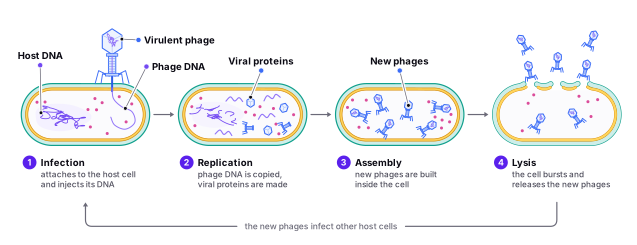
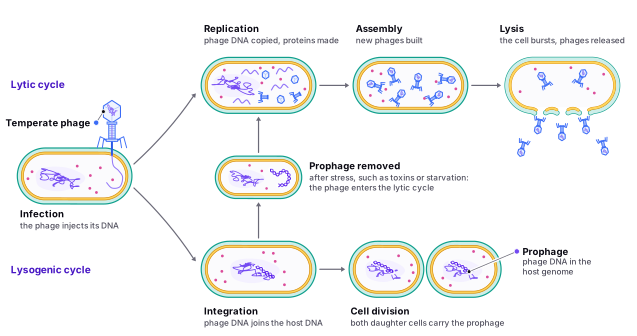
The lytic cycle is the process by which a virus invades a host cell, replicates itself, and then lyses (breaks open) the host cell to release the new virus particles. This is a fast and efficient way for the virus to spread, but it also causes damage to the host cell and can ultimately lead to the death of the host.
On the other hand, the lysogenic cycle involves the integration of the virus's genetic material into the host cell's DNA. This genetic material remains dormant, or latent, until triggered by some external factor, such as stress or a change in the host's environment. When this trigger occurs, the virus's genetic material is activated and begins replicating, eventually leading to the lytic cycle and the release of new virus particles.
The lytic and lysogenic cycles are two distinct modes of viral replication, each with its own unique characteristics and impacts on host cells. In this discussion, we will delve into the details of each cycle and emphasize their differences.
Lytic cycle:
- Infection: In the lytic cycle, a virus attaches itself to a host cell by binding to specific receptors on the cell surface. Once attached, the virus injects its genetic material (either DNA or RNA) into the host cell.
- Replication: The viral genetic material hijacks the host cell's machinery to replicate its own genome and synthesize viral proteins. This process can be rapid, sometimes producing thousands of new viral particles within hours.
- Assembly: The newly synthesized viral components, including the genetic material and capsid proteins, are assembled into complete viral particles within the host cell.
- Lysis: As the number of viral particles increases, the host cell becomes overwhelmed and eventually ruptures, releasing the new virus particles to infect neighboring cells. This lysis of the host cell can cause damage to the host organism and lead to symptoms of viral infection.
Lysogenic cycle:
- Infection and Integration: Similar to the lytic cycle, the lysogenic cycle begins with a virus attaching itself to a host cell and injecting its genetic material. However, instead of immediately hijacking the host cell machinery, the viral genetic material integrates itself into the host cell's DNA, becoming a prophage. This integration allows the viral genome to remain dormant, or latent, within the host cell.
- Dormancy: During the lysogenic cycle, the host cell continues to function and replicate normally, with the integrated viral DNA replicating along with the host's own genetic material. The virus remains dormant until some external factor, such as stress, UV radiation, or a change in the host's environment, triggers its activation.
- Activation: When the viral genome is activated, it excises itself from the host cell's DNA and initiates the lytic cycle. This involves replicating its own genome, synthesizing viral proteins, assembling new viral particles, and ultimately lysing the host cell to release new virus particles.
The main differences between the lytic and lysogenic cycles lie in their impacts on host cells and their replication strategies. In the lytic cycle, the virus rapidly replicates and destroys the host cell, causing direct harm and potentially leading to symptoms of infection. In the lysogenic cycle, the virus maintains a more covert presence within the host cell, remaining dormant until activated by external factors. This dormancy allows the host cell to continue functioning normally until the viral genome is activated, at which point the lytic cycle is initiated, and new viral particles are produced.
Understanding the differences between these two modes of viral replication is essential for the study of viral infections and the development of antiviral strategies, as the approach to treatment may differ depending on whether a virus primarily undergoes a lytic or lysogenic cycle.
Virulent vs. Temperate Viruses
Virulent and temperate viruses exhibit different life cycles when infecting host cells. The primary distinction between the two lies in their strategies for survival and replication.
Virulent viruses: These viruses follow a lytic life cycle, which involves rapid replication and destruction of the host cell. Upon infecting the host cell, the virulent virus hijacks the host's cellular machinery to replicate its genetic material and produce new viral particles. Once the replication process is complete, the newly formed viral particles burst out of the host cell, leading to its destruction or lysis. This process releases a large number of viruses into the surrounding environment, allowing them to infect more host cells. Examples of virulent viruses include some bacteriophages (viruses that infect bacteria) and many human pathogenic viruses, such as the influenza virus.
Find it in the figure
Coming soon for figure 12.2
Temperate viruses: These viruses follow a lysogenic life cycle, which allows them to integrate their genetic material into the host's genome without immediately destroying the host cell. The viral genetic material, called a prophage in the case of bacteriophages, remains dormant within the host's DNA and is replicated along with the host's genetic material during cell division. This dormant state can persist for an extended period until certain environmental factors or stressors trigger the activation of the viral genes. Once activated, the virus switches to the lytic cycle, leading to the production of new viral particles and the eventual lysis of the host cell. An example of a temperate virus is the bacteriophage lambda.
Find it in the figure
Coming soon for figure 12.3
In summary, the key difference between virulent and temperate viruses is their life cycle strategy. Virulent viruses follow a lytic life cycle, which involves rapid replication and destruction of the host cell, while temperate viruses follow a lysogenic life cycle, integrating their genetic material into the host's genome and remaining dormant until specific conditions trigger their activation and transition to the lytic cycle.
Transduction
Viral transduction is the process by which a virus transfers genetic material from one bacterium to another. This process can have significant implications for bacterial evolution, as it enables the exchange of genetic information between different bacterial species, leading to the acquisition of new traits, such as antibiotic resistance. Transduction is carried out by bacteriophages, viruses that specifically infect bacteria. There are two main types of transduction: generalized transduction and specialized transduction. We will discuss each type in detail, emphasizing their differences.
Generalized transduction:
- In generalized transduction, the bacteriophage accidentally packages a segment of the host bacterium's DNA into its capsid instead of its own viral DNA during the lytic cycle. This can occur when the host cell's DNA is mistakenly recognized as viral DNA by the bacteriophage's replication machinery.
- When the bacteriophage infects a new host bacterium, it injects the mistakenly packaged bacterial DNA into the new host cell. The recipient bacterium can then incorporate this foreign DNA into its own genome through a process called recombination. As a result, the recipient bacterium acquires new genetic traits from the donor bacterium.
- Generalized transduction is considered a random process, as any portion of the donor bacterium's DNA can be accidentally packaged into the bacteriophage and transferred to the recipient bacterium.
Specialized transduction:
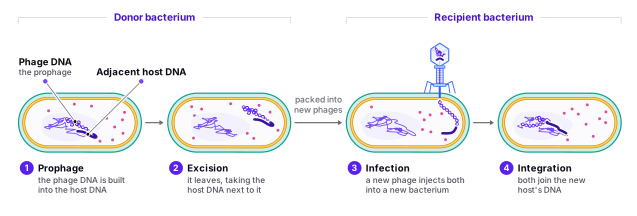
- Specialized transduction occurs when a bacteriophage that has integrated its genetic material into the host bacterium's genome (as a prophage) during the lysogenic cycle, excises itself from the host DNA to initiate the lytic cycle. However, during this excision process, the bacteriophage may accidentally excise a small portion of the host bacterium's DNA adjacent to the prophage, incorporating it into the viral genome.
- When the bacteriophage infects a new host bacterium, it injects its viral DNA, along with the excised bacterial DNA, into the recipient cell. The recipient bacterium can then incorporate this foreign DNA into its own genome through recombination, acquiring new genetic traits from the donor bacterium.
- Unlike generalized transduction, specialized transduction is not random; it only transfers specific genes located near the prophage's integration site within the donor bacterium's genome.
Find it in the figure
Coming soon for figure 12.4
Let us use analogies to make consolidate what you have read so far regarding transduction:
Specialized transduction is like a courier who delivers a package to a specific address. The courier knows exactly where the package needs to go, and only delivers it to that address. In the same way, specialized transduction involves a virus that can only infect specific cells and deliver its genetic material to a specific location in the host's DNA.
Generalized transduction, on the other hand, is like a postal worker who delivers mail to every mailbox on a given route. The postal worker doesn't know which mailbox belongs to whom, so every mailbox gets the same mail. In the same way, generalized transduction involves a virus that can infect a wide range of cells and insert its genetic material into random locations in the host's DNA.
In summary, viral transduction is a mechanism by which bacteriophages transfer genetic material between bacteria. Generalized transduction involves the random packaging of bacterial DNA during the lytic cycle, while specialized transduction occurs during the excision of a prophage from the host bacterium's genome during the lysogenic cycle. Both types of transduction can lead to the transfer of genetic traits between bacterial species, with implications for bacterial evolution and the spread of antibiotic resistance.
Section 12.4
Viruses in the Field of Medicine
Viruses have played a significant role in the field of medicine and biotechnology, providing valuable tools for research, diagnostics, and therapeutics. In this discussion, we will explore several ways viruses are utilized in these fields, including vaccines, gene therapy, oncolytic viruses, and viral vectors for research.
Vaccines: Vaccines are one of the most successful applications of viruses in medicine. They are designed to stimulate the immune system to produce an immune response against a specific virus without causing the disease itself. Traditional vaccines often use inactivated or attenuated (weakened) viruses, while newer vaccines, such as the COVID-19 mRNA vaccines, use viral components or genetic material to induce an immune response. Examples: The smallpox vaccine (using the vaccinia virus) played a crucial role in eradicating smallpox, while vaccines against measles, mumps, and rubella (MMR vaccine) have significantly reduced the incidence of these diseases.
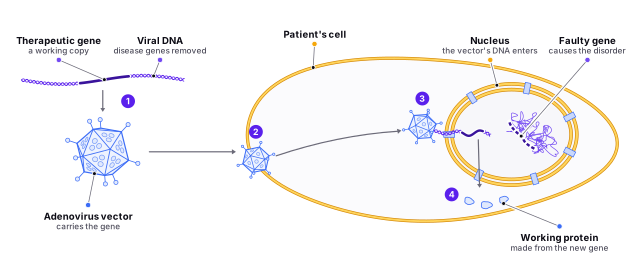
Gene therapy: Gene therapy involves the use of viruses to deliver genetic material into a patient's cells to treat or prevent genetic disorders. Viral vectors, such as adeno-associated viruses (AAV) or lentiviruses, are engineered to carry therapeutic genes and efficiently deliver them to target cells without causing disease. Examples: Luxturna is an AAV-based gene therapy for a rare form of inherited blindness. Zolgensma, another AAV-based therapy, treats spinal muscular atrophy in young children.
Oncolytic viruses: Oncolytic viruses are viruses that selectively infect and destroy cancer cells while leaving healthy cells largely unharmed. These viruses can be naturally occurring or genetically engineered to specifically target cancer cells. They work by infecting cancer cells, replicating within them, and ultimately causing cell death, while also stimulating the immune system to attack cancer cells. Examples: Talimogene laherparepvec (T-VEC or Imlygic) is an FDA-approved oncolytic virus for the treatment of advanced melanoma. It is a modified herpes simplex virus that selectively replicates in cancer cells and produces a protein that stimulates the immune system.
Viral vectors for research and diagnostics: Viruses are also used as tools for molecular biology research and diagnostics. Viral vectors, such as lentiviruses or adenoviruses, can be used to deliver genes, small RNAs, or other molecules of interest into cells for functional studies or to create stable cell lines for research purposes. In diagnostics, viral proteins or genetic material can be detected using techniques such as polymerase chain reaction (PCR), enzyme-linked immunosorbent assay (ELISA), or nucleic acid sequencing to confirm the presence of a viral infection.
Find it in the figure
Coming soon for figure 12.5
You need not know these examples in detail for your exam, but it is useful to be aware of the interesting ways viruses have been utilized extensively in medicine and biotechnology, providing valuable tools for research, diagnostics, and therapeutics. From vaccines to gene therapy and oncolytic viruses, these applications have transformed our understanding of biology and have led to the development of life-saving treatments for numerous diseases.
Section 12.5
Viral Transmission
Viral transmission is the process by which a virus spreads from one individual or organism to another. It is a crucial aspect of viral infections and plays a significant role in the epidemiology and evolution of viruses. Understanding the various modes of viral transmission helps in the development of strategies to control and prevent the spread of viral diseases. In this discussion, we will explore different methods of viral transmission, focusing on the roles of vectors and hosts in the process.
Direct transmission: Direct transmission occurs when a virus is transferred directly from an infected individual to a susceptible individual without any intermediary. Common modes of direct transmission include physical contact (touching, kissing, or sexual contact), respiratory droplets (coughing or sneezing), and vertical transmission (from mother to offspring during pregnancy, childbirth, or breastfeeding).
Indirect transmission: Indirect transmission involves the transfer of a virus from an infected individual to a susceptible individual through an intermediary, such as an inanimate object or a living organism. The intermediary is often referred to as a “vector” or “host.”
Vectors: Vectors are living organisms that can transmit a virus from an infected host to a susceptible host. They are typically arthropods, such as mosquitoes, ticks, and flies. Vectors acquire the virus by feeding on the blood or other body fluids of an infected host and then transmit it to a susceptible host during a subsequent feeding event. Vector-borne viral transmission can be divided into two categories: mechanical and biological. Mechanical transmission: In mechanical transmission, the virus is passively carried on the external surface of the vector. When the vector comes into contact with a susceptible host, the virus is transferred to the new host. This type of transmission does not involve the replication of the virus within the vector. Biological transmission: In biological transmission, the virus actively replicates within the vector before being transmitted to a susceptible host. This often involves a period of “extrinsic incubation,” during which the virus must replicate and disseminate within the vector before becoming infectious.
Hosts: Hosts are organisms that are infected by a virus and can serve as a source of viral transmission to other susceptible individuals. Hosts can be classified into various categories based on their role in the transmission cycle: Reservoir hosts: Reservoir hosts are animals that maintain the virus in nature and can serve as a source of infection for vectors or other susceptible hosts. Reservoir hosts typically do not show signs of illness when infected with the virus. Amplifying hosts: Amplifying hosts are organisms that become infected with a virus, replicate it to high levels, and contribute to its transmission to other susceptible hosts or vectors. Amplifying hosts often play a critical role in the spread of viral diseases during outbreaks or epidemics. Dead-end hosts: Dead-end hosts are organisms that become infected with a virus but do not contribute to its transmission. Infections in dead-end hosts typically result in a dead-end for the virus, as they are unable to transmit the virus to other susceptible hosts or vectors.
In summary, viral transmission is the process by which viruses spread from one individual or organism to another. The modes of transmission can be direct or indirect, involving vectors and various types of hosts. Understanding the mechanisms of viral transmission is essential for the development of strategies to control and prevent the spread of viral diseases.