







Chapter 5IMAT Biology
Energy and Metabolism
- 5.1Coupling Reactions
- 5.2Catabolism and Anabolism
- 5.3Energy
- 5.4The Laws of Thermodynamics
- 5.5Enzymes
- 5.6Why ATP?
- 5.7Cellular Respiration
- 5.8Energy in Biology
- 5.9Glucose
- 5.10Glycolysis
- 5.11The Krebs Cycle
- 5.12The Electron Transport Chain
- 5.13Oxidative Phosphorylation
- 5.14Summary of the Yields of the Different Biochemical Pathways
Metabolism is the sum of all the chemical reactions that take place in an organism, from the breakdown of nutrients to the synthesis of macromolecules. These reactions are essential for life and provide the energy and building blocks needed for growth, repair, and maintenance of all living systems.
Metabolism can be divided into two categories: catabolism and anabolism. Catabolism involves the breakdown of molecules to release energy, which is then used to power cellular processes. This includes the breakdown of carbohydrates, fats, and proteins into simpler molecules such as , fatty acids, and amino acids. The energy released during catabolism is stored in the form of (adenosine triphosphate), the main energy currency of the cell.
Anabolism, on the other hand, involves the synthesis of larger molecules from smaller ones, using energy in the form of ATP. This includes the synthesis of macromolecules such as proteins, nucleic acids, and polysaccharides, as well as the storage of energy in the form of glycogen and fats.
Together, catabolism and anabolism work to maintain the delicate balance of energy and nutrients in the body. This balance is essential for the proper functioning of all physiological processes and is regulated by a complex network of enzymes and hormones.
One of the key molecules involved in metabolism is ATP, or adenosine triphosphate. ATP is a nucleotide that serves as the main energy source for cells. It is produced through the breakdown of glucose and other molecules in a process called cellular respiration, which occurs in the mitochondria of cells.
ATP works like a “currency” of energy within cells. When a cell needs the energy to perform a particular function, it can “spend” ATP by breaking it down into ADP (adenosine diphosphate) and releasing the energy stored in the molecule. This energy can then be used to power various processes, such as muscle contractions, synthesis of molecules, and transport of ions across membranes. ADP can also be broken down into AMP, Adenosine mono-phosphate, but this process is less common and out was never asked on the IMAT.
To clarify the analogy, you can think of ATP as a battery that stores energy. When you need to use your phone, you “spend” the energy stored in the battery by plugging it into the phone. Similarly, when a cell needs energy, it “spends” ATP by breaking it down and releasing the stored energy.
When you get back home, you can recharge your battery by connecting it to the AC socket, which is equivalent to the process of cellular respiration, which allows us to take an uncharged battery (ADP or AMP) and fully charge it again (ATP) for the next time you need it.
Metabolism is the set of chemical reactions that maintain life in an organism. ATP is a key molecule involved in metabolism, serving as the main energy source for cells. It can be “spent” to power various processes in the cell.
ATP + H2O → ADP + Pi + free energy
The equation above demonstrates the hydrolysis of one charged phosphate group from an ATP molecule. This process is very exothermic, and releases plenty of free energy.
Section 5.1
Coupling Reactions
Energy coupling is a critical process in biological systems that enables the transfer of energy from one reaction to another. This process allows cells to perform vital functions, such as synthesizing complex molecules, moving substances across membranes, and contracting muscles.
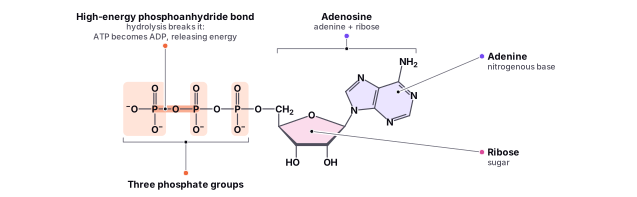
The process of energy coupling involves the use of high-energy molecules, such as ATP, to provide the energy needed to drive other cellular processes. ATP is an essential molecule in cells that serves as the primary source of energy for cellular reactions. It is composed of a nitrogenous base (adenine), a sugar molecule (ribose), and three phosphate groups.
The third phosphate group of ATP is connected to the molecule by a high-energy phosphoanhydride bond, which stores a considerable amount of energy. When this bond is broken by hydrolysis, the molecule is converted into ADP (adenosine diphosphate), and a significant amount of energy is released. This energy can be harnessed by the cell to drive other reactions that would otherwise require an input of energy.
An example of energy coupling is the synthesis of proteins, which requires the input of energy to form peptide bonds between amino acids. This energy is provided by the hydrolysis of ATP, which releases energy that can be used to drive the formation of peptide bonds. Another example is the transport of ions across cell membranes, which requires the use of energy to move the ions against their concentration gradient. This energy is provided by the hydrolysis of ATP, which powers the ion pumps that move the ions across the membrane.
In summary, energy coupling is a critical process in biology that allows cells to perform work by transferring energy from one reaction to another. ATP serves as a crucial molecule in this process by providing the energy needed to drive other cellular reactions.
Section 5.2
Catabolism and Anabolism
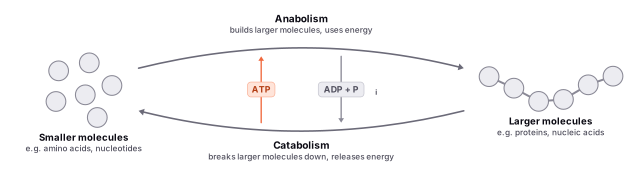
Catabolism and anabolism are two essential processes that take place within cells as part of metabolism. Metabolism refers to the sum of all chemical reactions occurring in an organism that are necessary for life. These reactions either break down complex molecules into simpler ones (catabolism) or synthesize complex molecules from simpler ones (anabolism).
Catabolism is the process of breaking down large molecules into smaller ones, usually to release energy. In catabolism, energy is often stored in molecules such as adenosine triphosphate (ATP), which serves as the primary energy currency for cells. Examples of catabolic processes include cellular respiration and digestion. In cellular respiration, glucose, a simple sugar, is broken down in a series of steps to produce ATP, carbon dioxide, and water. During digestion, complex food molecules are broken down into simpler nutrients that can be absorbed and used by the body.
Anabolism, on the other hand, is the process of synthesizing complex molecules from simpler ones, often requiring energy input. Anabolic processes build and repair the body's structures, such as tissues and organs, and are essential for growth and development. Examples of anabolic processes include protein synthesis, in which amino acids are linked together to form proteins, and the synthesis of nucleic acids, such as DNA and RNA, from nucleotides. In both cases, the energy required for these processes often comes from ATP produced during catabolic reactions.
In summary, catabolism and anabolism are two key processes in metabolism that work together to maintain a balance between the breakdown and synthesis of molecules within cells. Catabolic processes release energy by breaking down complex molecules into simpler ones, while anabolic processes use energy to build complex molecules from simpler ones. Understanding these processes helps provide insight into the functioning of living organisms and how they maintain the energy necessary for life.
Find it in the figure
Coming soon for figure 5.1
Section 5.3
Energy
Energy is a fundamental concept in science that describes the ability of things to do work and make changes happen. It is what powers our bodies, fuels our cars, and generates electricity. But energy comes in different forms and is constantly changing.
One type of energy is potential energy, which is stored energy that is waiting to be used. This can be compared to a ball at the top of a hill, which has the potential to roll down and push something.
Another type of energy is kinetic energy, which is energy in motion. This can be compared to a ball rolling down the hill, which has the energy to push something because it is moving.
Free energy is a type of energy that is available to do work. This can be compared to a battery, which has stored energy that can be used to power a device like a flashlight. In biology, the free energy that is released when ATP is hydrolyzed can be used to drive reactions and perform work in the cell.
Activation energy is the energy that is needed to start a reaction. This can be compared to starting a fire, where a match is needed to provide the activation energy to initiate the combustion reaction. In biology, enzymes lower the activation energy needed for reactions to occur, allowing them to happen more efficiently.
In summary, energy is a complex and fascinating concept that drives the world around us. Understanding the different types of energy and how they interact is essential to understanding the processes that occur in our bodies and in the world we live in.
In the next chapter, we will cover all of the different types of energy that are important to know for the IMAT exam.
Section 5.4
The Laws of Thermodynamics
The laws of thermodynamics are a set of rules that tell us about energy and how it can be changed. There are multiple rules, but these are the most important to remember:
The laws of thermodynamics provide a fundamental understanding of the behavior of energy and how it can be transformed. The first law of thermodynamics is also known as the law of energy conservation, which tells us that energy cannot be created or destroyed, only transformed from one form to another. This means that the total amount of energy in the universe remains constant.
An analogy for the first law is a bank account. You can't create or destroy money, but you can move it from one account to another or change its form, such as converting cash into digital currency. Similarly, energy can be transformed from one form to another, such as chemical energy being converted to heat or mechanical energy.
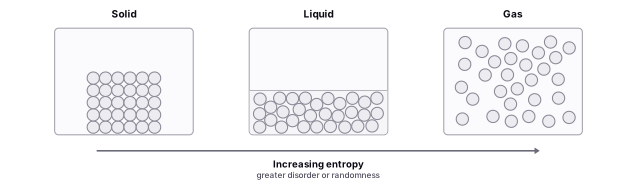
The second law of thermodynamics is a fundamental principle in physics that describes the behavior of energy and entropy in a system. The second law states that in any physical process, the combined entropy (a measure of the disorder or randomness of a system) of the system and the environment must increase if the process is irreversible. An analogy for the second law is a messy room. Without any outside intervention, a room will become more disordered over time. To clean up the room and restore order, energy must be added in the form of physical work.
In other words, the final entropy of the system must be greater than the initial entropy for an irreversible process to occur. This can be represented by the equation Sf > Si, where Sf is the final entropy and Si is the initial entropy.
An irreversible process is one that cannot be reversed, such as the mixing of two gases or the transfer of heat from a hotter body to a colder body. In these processes, the combined entropy of the system and the environment increases, because the total amount of disorder or randomness in the system has increased.
On the other hand, a reversible process is one that can be reversed without any loss of energy or increase in entropy. For example, a gas that is allowed to expand and contract reversibly in a cylinder with a movable piston can be returned to its original state without any increase in entropy. In this case, the final entropy of the system would be equal to the initial entropy, or Sf = Si.
The third law of thermodynamics deals with the behavior of matter at extremely low temperatures. The law states that as the temperature of a system approaches absolute zero, the entropy of the system approaches a minimum value. This law helps to explain why certain materials, such as metals, can become superconducting at extremely low temperatures, which is useful for various technologies such as MRI machines.
These laws help us understand how energy works and how it can be used in different ways. They also help us understand why we can't have unlimited energy, and why we always have to be careful about how we use it.
Entropy
Entropy is a fundamental concept in thermodynamics that is crucial to understanding the behavior of energy and matter in physical systems. To put it simply, entropy is a measure of the disorder or randomness of a system. The greater the disorder or randomness of the molecules in a system, the higher its entropy.
An analogy to help understand entropy is to think of a room that is messy and disorganized. The more cluttered and disordered the room is, the higher its entropy. Conversely, a well-organized and neat room has a lower entropy. This analogy can be extended to any physical system, where a higher entropy corresponds to a greater degree of disorder or randomness.
In thermodynamics, entropy is a measure of the amount of thermal energy in a system that is unavailable to do useful work. This is because work is obtained from ordered molecular motion, so a more disordered or random system has less ordered motion and thus less available energy to do useful work. The unit of measurement for entropy is joules per Kelvin, which represents the amount of thermal energy per unit temperature that is unavailable to do work.
Entropy plays a crucial role in many physical processes, such as the transfer of heat and the flow of energy in chemical reactions. In general, any process that results in an increase in the disorder or randomness of a system will result in an increase in entropy. This is known as the second law of thermodynamics, which states that the total entropy of an isolated system always increases over time.
Understanding entropy is essential for understanding many important phenomena in various fields such as science and engineering, from the behavior of matter at extremely low temperatures to the efficiency of engines and power plants.
Find it in the figure
Coming soon for figure 5.2
Enthalpy
Enthalpy is a measure of the energy in a chemical system. It is the total heat energy measured when the pressure is constant.
Enthalpy is a state function whose change indicates the amount of heat transferred from a system to its surroundings or vice versa, at constant pressure. The change in the internal energy of a system is the sum of the heat transferred and the work done.
Heat energy is the result of the movement of tiny particles called atoms, molecules or ions in solids, liquids and gases. Heat energy can be transferred from one object to another. The transfer or flow due to the difference in temperature between the two objects is called heat
So, in simpler words, “Heat energy” is the energy that is produced when two things with different temperatures are brought together. For example, if you touch a hot pan, you will feel heat because the heat energy is transferred from the pan to your hand.
Chemical energy is the potential energy that is stored in the bonds between atoms in a chemical compound. For example, gasoline has a lot of chemical energy because the atoms in gasoline are bonded together very strongly. When gasoline is burned, chemical energy is released as heat energy.
Enthalpy is essential because it helps us understand how energy is transferred and used in chemical reactions. By measuring the change in enthalpy of a reaction, we can predict how much energy will be released or absorbed during the reaction. This helps us understand how different chemicals will react with each other and how much energy we can get from them.
Activation Energy and Enzymes
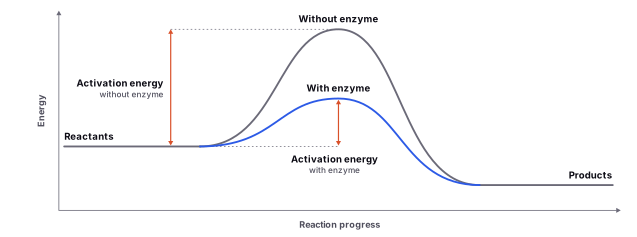
Activation energy is the minimum amount of energy that is required for a chemical reaction to occur. It is like a barrier that must be overcome before a reaction can proceed.
An analogy to help understand activation energy is to think of a ball rolling up a hill. The ball represents the reactants in a chemical reaction, and the hill represents the activation energy. In order for the ball to reach the top of the hill, it must first be pushed with enough force to overcome the resistance of the hill. Similarly, in a chemical reaction, the reactants must be supplied with enough energy to overcome the activation energy before they can transform into products.
Activation energy is important because it determines the rate at which a chemical reaction will occur. A reaction with a high activation energy will proceed more slowly than a reaction with a lower activation energy. Enzymes, which are specialized proteins that catalyze chemical reactions in the body, lower the activation energy required for a reaction to occur. This allows the reaction to occur more quickly and efficiently, making it possible for life-sustaining processes to occur in our bodies.
In summary, activation energy is an essential concept in chemistry because it determines the rate at which reactions occur. Enzymes play an important role in lowering activation energy, making chemical reactions in our bodies more efficient and allowing life-sustaining processes to occur.
There are several factors that can affect the rate of a chemical reaction, including:
Temperature: Increasing the temperature of the reactants will generally increase the rate of the reaction because it increases the average kinetic energy of the reactants, making it more likely that they will have the required activation energy. Imagine two people playing catch with a ball. If they stand close together and throw the ball slowly, the chance of a successful catch is low. However, if they stand further apart and throw the ball faster, the chance of a successful catch is higher. Similarly, if the reactant molecules are moving faster due to higher temperature, the chance of a successful collision and reaction is higher.
Catalysts: Catalysts are substances that can reduce the activation energy of a chemical reaction by providing an alternative pathway with a lower activation energy. This allows the reaction to occur more quickly and easily. Catalysts, like enzymes in our bodies, are like a shortcut or a slide in a playground, just like how a slide helps a child to move down faster, a catalyst can help reactant molecules to overcome the activation energy barrier faster.
Surface area: Increasing the surface area of the reactants can also increase the rate of the reaction because it increases the number of reactant molecules that are exposed to each other, increasing the chance of successful collisions. Imagine trying to dissolve sugar cubes in water. If the sugar cubes are whole, it will take longer to dissolve. However, if the sugar cubes are crushed into smaller pieces, the surface area increases, and the rate of dissolving will be faster.
Concentration: Increasing the concentration of the reactants will generally increase the rate of the reaction because it increases the number of reactant molecules that are present, increasing the chance of successful collisions.
Understanding the concept of activation energy is important in predicting and controlling the rate of biochemical reactions.
Section 5.5
Enzymes
Enzymes are special proteins that help chemical reactions happen faster. They do this by lowering the activation energy needed for the reaction to start.
Imagine you are trying to climb a tall mountain. The mountain is the chemical reaction and you are the enzyme. The activation energy is the energy it takes for you to start climbing the mountain.
If the mountain is very steep and rocky, it will be hard for you to start climbing because it will take a lot of energy. But if the mountain has a gentle slope and smooth paths, it will be easier for you to start climbing because it won't take as much energy.
Enzymes remove the rocks and obstacles from the mountain, making it much easier for you to start climbing, while also allowing you to climb faster.
Find it in the figure
Coming soon for figure 5.3
Types of Enzymes
As mentioned earlier, enzymes are proteins that catalyze chemical reactions in the cell. They play a critical role in many cellular processes, including metabolism, DNA replication and repair, and signaling pathways. There are many different types of enzymes, each with its own specific function. Here are some examples:
Metabolic enzymes: These catalysts are involved in the biochemical reactions that occur within cells to produce energy, synthesize new molecules, and break down waste products. Examples include enzymes that break down sugars for energy, synthesize lipids, and detoxify harmful substances.
Digestive enzymes: These enzymes are produced by the digestive system to break down food into small molecules that can be absorbed and used by the body. Examples include amylases that break down carbohydrates, proteases that break down proteins, and lipases that break down fats.
DNA-processing enzymes: These enzymes are involved in the synthesis and repair of DNA. Examples include polymerases that synthesize new DNA strands, helicases that unwind DNA strands, and ligases that seal breaks in the DNA helix.
Signal transduction enzymes: These enzymes are involved in the signaling pathways that transmit messages within and between cells. Examples include kinases that transfer phosphate groups to proteins and phosphatases that remove phosphate groups from proteins.
Main Categories of Enzymes
Enzymes are classified into six main categories based on the type of chemical reaction they catalyze. These categories are oxidoreductases, transferases, hydrolases, lyases, isomerases, and ligases.
Oxidoreductases: These enzymes catalyze oxidation-reduction reactions, where one molecule is oxidized while another is reduced. One example of an oxidoreductase is , which catalyzes the conversion of to during the process of cellular respiration. An analogy for an oxidoreductase is a seesaw, where one end goes up as the other goes down.
Transferases: These enzymes catalyze the transfer of a functional group, such as a phosphate or methyl group, from one molecule to another. An example of a transferase is , which transfers a phosphate group from ATP to glucose during . An analogy for a transferase is a conveyor belt, where items are passed from one station to another.
Hydrolases: These enzymes catalyze the hydrolysis of a chemical bond using water. One example of a hydrolase is lactase, which breaks down lactose into glucose and galactose. An analogy for a hydrolase is a pair of scissors, cutting a piece of paper into smaller pieces.
Lyases: These enzymes catalyze the cleavage of a chemical bond in a molecule without the addition of water. An example of a lyase is carbonic anhydrase, which converts carbon dioxide into bicarbonate and hydrogen ions. An analogy for a lyase is a pair of scissors cutting a piece of fabric, without any water or other substance involved.
Isomerases: These enzymes catalyze the rearrangement of atoms within a molecule, converting one isomer into another. One example of an isomerase is , which catalyzes the interconversion of and during glycolysis. An analogy for an isomerase is a puzzle piece being rotated or flipped to fit in a different position.
Ligases: These enzymes catalyze the joining of two molecules together, often coupled with the hydrolysis of ATP. One example of a ligase is DNA ligase, which joins together the Okazaki fragments during DNA replication. An analogy for a ligase is a glue that binds two pieces of paper together.
Understanding the different types of enzymes and their functions is essential in understanding the biochemical reactions that occur within cells and how they are regulated.
Enzyme Structure
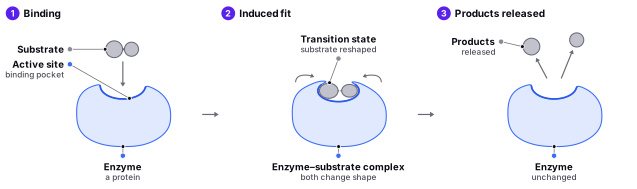
The structure of an enzyme is complex and is essential for its function. Enzymes are made up of one or more polypeptide chains, which are long chains of amino acids. These chains are folded into a specific three-dimensional shape, called the enzyme's active site. The active site is the region of the enzyme where the chemical reaction takes place.
The active site is where the substrate, which is the reactant that the enzyme acts upon, binds to the enzyme. The substrate fits into the active site like a key fits into a lock. This specific fit between the substrate and the active site is called the enzyme-substrate complex.
There are also other binding sites on an enzyme that play important roles in its function. One such site is the allosteric site, which is a regulatory site on the enzyme that can bind to a molecule called an allosteric effector. The allosteric effector can either inhibit or activate the enzyme, depending on the type of effector and the enzyme. The allosteric site can be compared to a light switch that can turn a light on or off. For example, when a cell needs a certain product, an allosteric activator can bind to the enzyme and increase its activity. On the other hand, an allosteric inhibitor can bind to the enzyme and decrease its activity when a product is in excess.
Another important binding site on an enzyme is the cofactor binding site. A cofactor is a non-protein molecule that is required for the enzyme to function properly. Cofactors can be metal ions, such as zinc or copper, or organic molecules, such as flavin adenine dinucleotide (FAD) or nicotinamide adenine dinucleotide (NAD). Cofactors are essential to enzyme function and can be compared to a chef's knife. Just like how a chef needs a knife to chop ingredients properly, an enzyme needs a cofactor to function properly. A metal ion cofactor can act as a catalyst, stabilizing an intermediate in the reaction, while an organic molecule cofactor can assist in the transfer of electrons.
In summary, the structure of an enzyme is complex and includes the active site, where the substrate binds, as well as other binding sites, such as the allosteric site and the cofactor binding site, which play important roles in the enzyme's function. Understanding the structure of enzymes and how they work is essential for understanding many biological processes and can also have practical applications in medicine and industry.
Active Site of Enzymes
Enzyme active sites and substrate specificity are fundamental concepts in understanding how enzymes function to catalyze biochemical reactions. These concepts play a significant role in many cellular processes, and it's important to grasp them thoroughly.
Enzymes are biological catalysts, which means they speed up chemical reactions without being consumed or permanently altered. They achieve this by lowering the activation energy required for a reaction to take place. Enzymes are proteins with a unique three-dimensional structure that allows them to interact specifically with their target molecules, called substrates.
The active site is a specific region on the enzyme's surface where the substrate binds. It is formed by a group of amino acids that create a pocket or groove, which is complementary in shape and chemical properties to the substrate. This is what gives enzymes their remarkable specificity, allowing them to recognize and bind only specific substrates.
Substrate specificity refers to the enzyme's ability to selectively recognize and bind to a particular substrate. This is often described using the lock-and-key analogy: the enzyme (the lock) has a specific shape that allows only the correct substrate (the key) to fit into the active site. This high level of specificity ensures that enzymes catalyze only the intended reactions, maintaining order and control in cellular processes.
There are many examples of enzymes with high substrate specificity. One example is the enzyme hexokinase, which is responsible for the first step in glycolysis, the process by which cells break down glucose to produce energy. Hexokinase specifically catalyzes the transfer of a phosphate group from ATP (adenosine triphosphate) to glucose, forming . The enzyme's active site has a precise shape that only accommodates glucose, ensuring that hexokinase does not mistakenly transfer the phosphate group to other molecules.
Another example is the enzyme trypsin, which plays a role in digestion by breaking down proteins into smaller fragments. Trypsin's active site is highly specific for peptide bonds that follow positively charged amino acids, such as lysine or arginine. This specificity enables trypsin to cleave proteins at precise locations, facilitating their further digestion and absorption.
In summary, enzyme active sites and substrate specificity are key factors that govern how enzymes interact with their substrates to catalyze chemical reactions. The unique three-dimensional structure of the active site allows enzymes to recognize and bind to specific substrates, ensuring that only the intended reactions occur within cells. Understanding these concepts is crucial for students studying biochemistry and molecular biology and preparing for the IMAT.
Find it in the figure
Coming soon for figure 5.4
Types of Inhibitors
In addition to different enzymes, there are also many different types of enzyme inhibitors, which are molecules that interfere with the activity of enzymes. Enzyme inhibitors can be classified into several categories:
Find it in the figure
Coming soon for figure 5.5
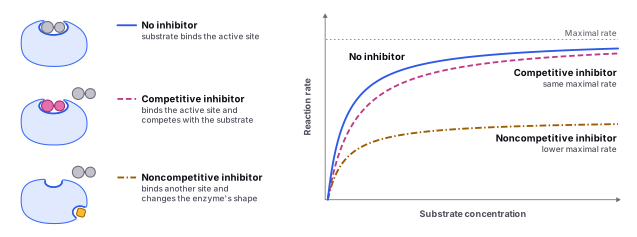
Competitive inhibitors: A competitive inhibitor is a type of inhibitor that competes with the substrate for binding to the active site of an enzyme. This means that the inhibitor and the substrate have a similar shape and can both bind to the enzyme, but only one can be converted into a product.
In the case of a competitive inhibitor, the inhibitor binds to the active site of the enzyme and blocks the substrate from binding and being converted into a product. As a result, the rate of the reaction is decreased and the amount of product produced is also decreased.
If we plot the reaction rate versus the concentration of the substrate, we can see the effect of a competitive inhibitor on the reaction. Initially, as the concentration of the substrate increases, the reaction rate also increases, following the curve of the enzyme's normal catalytic activity. However, as the concentration of the competitive inhibitor increases, it begins to compete with the substrate for binding to the active site of the enzyme. This causes the reaction rate to decrease and the curve to flatten out.
Eventually, the reaction reaches a point where the concentration of the substrate is so high that it effectively blocks the competitive inhibitor from binding to the enzyme and the reaction rate becomes constant. However, it takes longer for the reaction to reach this point because of the competitive inhibitor. The total amount of product produced is the same as it would be without the inhibitor, but it takes longer to produce because the reaction rate is slowed down.
It is important to note that competitive inhibitors can be overcome by increasing the concentration of the substrate. Since the inhibitor is only competing with the substrate for binding to the active site, increasing the concentration of the substrate allows more substrate to bind and be converted into product, overcoming the inhibitory effect of the competitive inhibitor.
Noncompetitive inhibitors: Noncompetitive inhibitors are a type of inhibitor that bind to a site on the enzyme other than the active site, and do not directly compete with the substrate for binding. Noncompetitive inhibitors can still decrease the overall rate of the reaction, but they do so by altering the shape of the enzyme, rather than blocking the substrate from binding.
If we plot the reaction rate versus the concentration of the substrate in the presence of a noncompetitive inhibitor, we will see a different pattern compared to a competitive inhibitor. Initially, the reaction rate will still increase with increasing substrate concentration, following the curve of the enzyme's normal catalytic activity. However, as the concentration of the noncompetitive inhibitor increases, it begins to bind to a site on the enzyme that is not the active site. This changes the shape of the enzyme and reduces its overall activity. As a result, the reaction rate begins to decrease, even at high substrate concentrations.
Unlike with a competitive inhibitor, increasing the concentration of the substrate will not overcome the inhibitory effect of a noncompetitive inhibitor. This is because the noncompetitive inhibitor is not directly competing with the substrate for binding to the active site, and increasing the concentration of the substrate will not change the shape of the enzyme and remove the inhibitory effect.
In the case of a noncompetitive inhibitor, the maximum reaction rate (Vmax) will be reduced, but the substrate concentration at which half the maximum reaction rate is reached (Km) will remain unchanged. This means that while the overall activity of the enzyme is reduced, the affinity of the enzyme for the substrate is not affected.
As a result, the curve of the reaction rate versus substrate concentration will not be shifted to the right, but it will be flattened, with a lower maximum reaction rate. This is because the noncompetitive inhibitor reduces the overall activity of the enzyme, causing the reaction rate to be slowed down at all substrate concentrations.
Uncompetitive inhibitors: An uncompetitive inhibitor is a type of enzyme inhibitor that specifically targets the enzyme-substrate complex, rather than the enzyme alone. This means that the inhibitor only binds to the enzyme-substrate complex and not to the free enzyme or the free substrate.
Once the enzyme-substrate complex is formed, the uncompetitive inhibitor binds to a site on the complex, causing a conformational change that prevents the conversion of the substrate into product. This reduction in the overall activity of the enzyme leads to a decrease in the reaction rate.
In the case of an uncompetitive inhibitor, the curve of the reaction rate versus substrate concentration is flattened, similar to a noncompetitive inhibitor. However, unlike a noncompetitive inhibitor, the maximum reaction rate (Vmax) and the substrate concentration at which half the maximum reaction rate is reached (Km) are both reduced. This means that the overall activity of the enzyme is decreased, as well as its affinity for the substrate.
An analogy for an uncompetitive inhibitor is a lock and key. The enzyme is like a lock and the substrate is like a key that fits perfectly into the lock's active site. The uncompetitive inhibitor is like a wedge that gets stuck between the key and the lock, preventing the lock from turning and opening. The wedge only fits between the key and the lock when they are together, so it specifically targets the lock-key complex and not the lock or the key alone.
Understanding the different types of enzyme inhibitors and their effects on the enzyme's activity and substrate affinity is important in many areas of biology, including drug development and understanding disease mechanisms.
Section 5.6
Why ATP?
ATP, or adenosine triphosphate, is an essential molecule that serves as the energy currency of the cell. It plays a crucial role in powering the various processes and systems within the cell, much like how gasoline is essential for a car to run.
There are several properties that make ATP well-suited for this role. First, ATP is a small molecule that is easily transported within cells, allowing it to be used wherever it is needed. Imagine ATP as a small container of gasoline that can be easily carried around and used to fuel different parts of the cell.
Second, ATP is highly reactive, meaning that it can readily release its energy when needed. This is similar to how gasoline is ignited to power an engine. ATP's reactivity allows it to release its energy quickly and efficiently, making it a suitable source of energy for rapid processes within the cell.
Finally, ATP can be synthesized and broken down quickly, allowing the cell to quickly replenish its supply of ATP as needed. This is similar to how a car's engine can quickly consume and replenish its supply of gasoline.
The energy stored in ATP is released through a process called hydrolysis, which involves the addition of a water molecule to the ATP molecule. This results in the breaking of one of the phosphate bonds in the ATP molecule, releasing energy in the process. This energy can then be used to power various cellular processes, such as the contraction of muscles, the synthesis of proteins, and the transportation of substances within the cell.
Overall, ATP is an essential molecule that plays a crucial role in the functioning of the cell. It serves as the energy currency that powers all of the cell's various systems and processes, much like how gasoline is essential for a car to run. Without ATP, the cell would be unable to perform its various functions, and life as we know it would not be possible.
Find it in the figure
Coming soon for figure 5.6
Section 5.7
Cellular Respiration
Cellular respiration is the process by which cells convert the energy stored in organic molecules, such as glucose, into a usable form, such as ATP. This process occurs in the mitochondria of cells and involves the breakdown of glucose through a series of chemical reactions known as the citric acid cycle, or the Krebs cycle.
There are two types of cellular respiration: respiration and aerobic respiration. Anaerobic respiration occurs in the absence of oxygen and involves the breakdown of glucose to produce ATP and lactic acid or ethanol. This type of respiration is less efficient than aerobic respiration, as it produces fewer ATP molecules per glucose molecule.
Aerobic respiration, on the other hand, occurs in the presence of oxygen and involves the breakdown of glucose to produce ATP and water. This type of respiration is more efficient than anaerobic respiration, as it produces more ATP molecules per glucose molecule. Aerobic respiration is the most common type of respiration in cells and is essential for the survival of most organisms.
Section 5.8
Energy in Biology
Redox Reactions
Redox reactions, short for reduction-oxidation reactions, are chemical processes in which the oxidation state of atoms or molecules changes. These reactions play a vital role in numerous biological processes and are critical to understanding energy production, metabolism, and cellular respiration. For high school students preparing for the IMAT, grasping the concept of redox reactions and their importance in biology is essential.
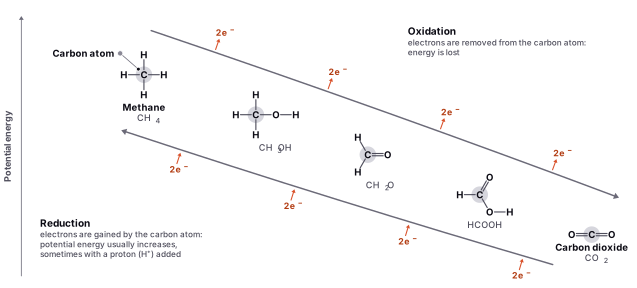
In redox reactions, there is a transfer of electrons between two species. One species loses electrons (oxidation), and the other species gains electrons (reduction). These processes always occur together, as the electrons lost by one species must be gained by another. The substance that loses electrons is called the reducing agent, while the substance that gains electrons is called the oxidizing agent.
To remember the process, you can use the mnemonic OIL RIG: Oxidation Is Loss (of electrons), Reduction Is Gain (of electrons).
Redox reactions are crucial in biological systems, particularly in energy production and metabolism. One of the most well-known examples is cellular respiration, where glucose is oxidized to release energy in the form of ATP (adenosine triphosphate). During this process, oxygen acts as the final electron acceptor and is reduced to water.
Another important example is photosynthesis, where plants convert sunlight into chemical energy. In this process, water is oxidized, releasing electrons and forming oxygen gas as a byproduct. The electrons are then used to reduce carbon dioxide to glucose, which the plant uses for energy and growth.
Redox reactions also play a role in detoxification within cells. For instance, the enzyme catalase converts toxic hydrogen peroxide (H2O2), a byproduct of cellular metabolism, into water and oxygen. This reaction involves a redox process where the hydrogen peroxide is reduced to water, while oxygen is formed as the oxidation product.
To further understand the importance of redox reactions in biology, consider the role of antioxidants. Antioxidants are molecules that protect cells from damage caused by free radicals, which are unstable and highly reactive species that can cause oxidative stress. Antioxidants work by undergoing redox reactions with free radicals, neutralizing them and preventing them from damaging cellular components such as DNA, proteins, and lipids.
In summary, redox reactions are chemical processes involving the transfer of electrons between species, with one undergoing oxidation and the other undergoing reduction. These reactions are fundamental to many biological processes, including energy production, metabolism, and detoxification. Understanding redox reactions and their importance in biology is crucial in understanding subsequent concepts.
Find it in the figure
Coming soon for figure 5.7
Electron Carriers
and FADH2 are electron carriers that play important roles in the production of energy in cells. They are used to transfer electrons from one molecule to another during the process of cellular respiration, which is the process by which cells convert the chemical energy stored in glucose and other organic molecules into a form that can be used to power the various functions of the cell.
Both NADH and FADH2 are used to transfer electrons from the breakdown of glucose to the electron transport chain, which is a series of protein complexes located in the mitochondria of cells. The electron transport chain is responsible for generating most of the energy used by cells in the form of ATP, which is the main energy currency of cells.
NADH and FADH2 carry potential energy because they are able to transfer their electrons to the electron transport chain, which generates ATP through a process called chemiosmosis. During chemiosmosis, the transfer of electrons through the electron transport chain pumps protons across the inner membrane of the mitochondria, creating a proton gradient. The energy stored in this proton gradient is then used to synthesize ATP.
NAD+ and FAD are involved in various metabolic pathways, including glycolysis, the citric acid cycle (also known as the Krebs cycle or TCA cycle), and the electron transport chain. Here, we'll discuss their roles in these pathways:
Glycolysis: This is the first step in breaking down glucose to produce energy. During glycolysis, glucose is converted into two molecules of pyruvate. In this process, NAD+ is reduced to NADH, capturing some of the energy stored in glucose. This NADH will later be used to produce ATP in the electron transport chain.
Citric Acid Cycle (TCA Cycle): After glycolysis, pyruvate is transported into the mitochondria, where it is converted into . Acetyl-CoA then enters the citric acid cycle, where it is further broken down to release energy. In this cycle, NAD+ is reduced to NADH and FAD is reduced to FADH2. Both NADH and FADH2 serve as electron carriers that will transport the captured energy to the electron transport chain.
Electron Transport Chain (ETC): The ETC is the final stage of cellular respiration, where the majority of ATP is produced. NADH and FADH2 donate their electrons to the ETC, which is a series of protein complexes embedded in the inner mitochondrial membrane. As electrons move through the ETC, they release energy that is used to pump protons across the membrane, creating a proton gradient. This gradient is harnessed by ATP synthase to generate ATP. At the end of the ETC, electrons are transferred to oxygen, which is reduced to water.
In summary, electron carriers like NAD+ and FAD are crucial for cellular respiration and metabolism. They participate in various metabolic pathways, capturing and transferring energy stored in chemical bonds to generate ATP. Understanding the roles of electron carriers in these processes is essential for students preparing for the IMAT, as they form a fundamental aspect of cellular energy production.
Section 5.9
Glucose
Why is Glucose Important in Metabolism?
Glucose is a simple sugar that plays a vital role in the energy metabolism of living cells. It is produced by plants through the process of photosynthesis, in which light energy is converted into chemical energy and stored in the bonds of glucose molecules.
When animals and other organisms consume glucose, either directly or by consuming plants that contain glucose, the glucose is used as a source of energy. The energy stored in glucose is used to power the chemical reactions that occur within cells, such as the synthesis of proteins, the production of ATP (the main energy currency of cells), and the transport of ions and molecules across cell membranes.
The study of glucose and its role in metabolism is particularly important because it is the primary fuel source for most living organisms. When we consume carbohydrates in our diet, such as bread or pasta, they are broken down into glucose in our digestive system and then transported to our cells through the bloodstream. Once inside the cell, glucose is used as a substrate for cellular respiration and energy production.
One of the reasons that glucose is such an effective energy storage molecule is because of its chemical structure. It has a simple, six-carbon structure that allows it to be easily broken down into smaller molecules during the process of cellular respiration.
Cellular respiration is the process by which cells convert the chemical energy stored in glucose and other organic molecules into a form that can be used to power the various functions of the cell. During cellular respiration, glucose is broken down in a series of reactions that release energy in the form of ATP. This ATP can then be used by cells to power their various functions.
The main biochemical pathways involved in metabolism, such as glycolysis, the Krebs cycle, the electron transport chain, and oxidative phosphorylation, are all centered around the metabolism of glucose. These pathways work together to break down glucose into smaller molecules, such as pyruvate, that can be further processed to produce ATP. Understanding the role of glucose in these pathways is essential for understanding how the body generates energy and maintains proper cellular function.
In addition to its role as an energy storage molecule, glucose also plays important roles in other cellular processes, such as signaling and the regulation of gene expression. For example, the concentration of glucose in the bloodstream is tightly regulated by hormones such as insulin and glucagon, which help to maintain a stable supply of energy for the body's cells.
Additionally, disorders related to glucose metabolism, such as diabetes, are a significant health concern. Diabetes is a condition in which the body is unable to properly regulate blood glucose levels, leading to high blood sugar levels that can damage organs and tissues over time. Understanding the biochemical pathways involved in glucose metabolism is crucial for developing treatments for diabetes and other related conditions.
In conclusion, the study of glucose and its role in metabolism is fundamental for understanding the functioning of living organisms, as it provides energy and is involved in a wide range of cellular processes. It is also important for understanding and treating disorders related to glucose metabolism, such as diabetes.
GLUTs
For cells to use glucose, it must first enter the cell. This process occurs through a transport protein called a glucose transport protein, or .
There are several different types of GLUT proteins, which are classified based on their structure and function. The most common type of GLUT protein is GLUT1, which is found in most cells and is responsible for the basal uptake of glucose. Other types of GLUT proteins, such as GLUT2, GLUT4, and GLUT12, are specialized for specific tissues or functions.
Once glucose enters the cell, it can be phosphorylated or modified by the addition of a phosphate group. This process occurs through a series of reactions called glycolysis, which takes place in the cytoplasm of the cell. The first step of glycolysis is the phosphorylation of glucose to form glucose-6-phosphate. This step is catalyzed by the enzyme hexokinase, which uses ATP as a source of energy.
Section 5.10
Glycolysis
Glycolysis is a crucial metabolic pathway that occurs in the cytosol of cells in all living organisms. It is responsible for breaking down glucose, a simple sugar, into two molecules of pyruvate. This process generates a small amount of adenosine triphosphate (ATP) and nicotinamide adenine dinucleotide (NADH). As the first step in cellular respiration, glycolysis is an anaerobic process, meaning it does not require oxygen.
Steps in Glycolysis
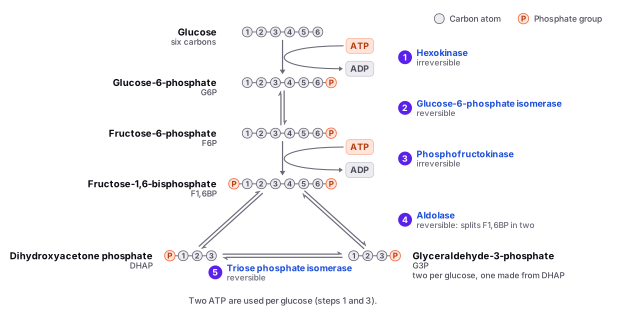
Let's break down the process into two stages: the energy-investment stage and the energy-payoff stage. Each stage consists of several steps, some of which are reversible, while others are irreversible. In the energy-investment stage, the cell gets ready to make energy, ATP is used to activate glucose and convert it into a molecule called glucose-6-phosphate. This molecule is then converted into , which is then converted into two molecules of a compound called glyceraldehyde-3-phosphate (G3P). In the energy-payoff stage, the G3P molecules are converted into pyruvate, producing ATP and NADH in the process. Let us look at these steps in more detail:
Energy-Investment Stage (Steps 1-5):
- Glucose phosphorylation (irreversible): An ATP molecule donates a phosphate group to glucose, forming glucose-6-phosphate (G6P) and ADP. This step, catalyzed by the enzyme hexokinase, is irreversible.
- (reversible): G6P is converted into fructose-6-phosphate (F6P) through a reversible isomerization reaction.
- Phosphofructokinase (irreversible): Another ATP molecule donates a phosphate group to F6P, producing (F1,6BP) and ADP. This step, catalyzed by phosphofructokinase, is irreversible and a key regulatory point in glycolysis.
- (reversible): F1,6BP is split into two molecules: glyceraldehyde-3-phosphate (G3P) and dihydroxyacetone phosphate (DHAP).
- Triose phosphate isomerase (reversible): DHAP is converted into another G3P molecule, resulting in two G3P molecules in total.
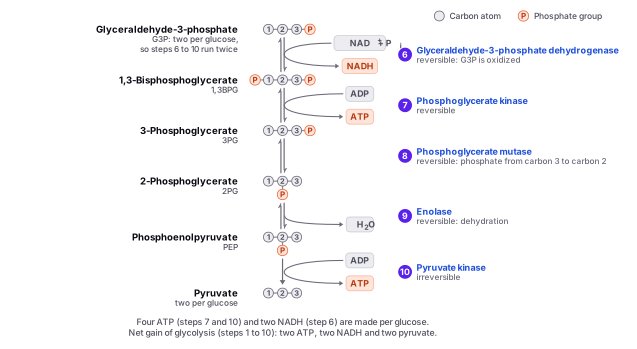
Energy-Payoff Stage (Steps 6-10):
- (reversible): Each G3P molecule is oxidized and gains a phosphate group, producing 1,3-bisphosphoglycerate (1,3BPG). In this process, two NAD+ molecules are reduced to two NADH molecules.
- (reversible): The phosphate group on each 1,3BPG is transferred to ADP, generating two ATP molecules and two 3-phosphoglycerate (3PG) molecules.
- (reversible): The phosphate group on each 3PG molecule is shifted from the 3rd carbon to the 2nd carbon, creating two 2-phosphoglycerate (2PG) molecules.
- (reversible): Each 2PG molecule undergoes dehydration, forming phosphoenolpyruvate ().
- (irreversible): The phosphate group on each PEP molecule is transferred to ADP, generating two ATP molecules and two pyruvate molecules. This step, catalyzed by pyruvate kinase, is irreversible.
Find it in the figure
Coming soon for figure 5.8
Find it in the figure
Coming soon for figure 5.9
Overall, glycolysis produces a net gainof two ATP molecules, two pyruvates and two NADH molecules per glucose molecule. It is an important metabolic pathway that allows cells to produce energy and support their functions.
It is important to remember that the entire pathway of glycolysis and cellular respiration always occurs twice for each glucose molecule. This means that for each glucose molecule broken down, the cell goes through the energy yield process of glycolysis and cellular respiration twice.
This is important because sometimes the IMAT exam writers may ask about the yield of glucose or pyruvate from one or both cycles. It is essential to pay attention to this detail and to understand whether the yield being discussed is from one cycle or both cycles.
Reversible and Irreversible Steps in Glycolysis
The significance of reversible and irreversible steps in glycolysis lies in the regulation of the pathway and the control of the rate of glucose metabolism. Reversible steps are those that can go in either direction, depending on the conditions and the requirements of the cell. Irreversible steps, on the other hand, can only proceed in one direction, which makes them key regulatory points in the pathway.
The reversible steps in glycolysis are important because they allow the cell to adjust the rate of glucose metabolism in response to changes in energy demand or substrate availability. For example, if the cell needs more ATP, the reversible steps can be pushed in the direction of ATP synthesis, while if there is excess ATP, the reversible steps can be pushed in the direction of glucose synthesis or other pathways.
In contrast, the irreversible steps in glycolysis serve as checkpoints to ensure that the pathway proceeds in a controlled and regulated manner. These steps are typically catalyzed by enzymes that are specific to the pathway and are regulated by feedback inhibition or other mechanisms.
For example, the enzyme hexokinase catalyzes the first step of glycolysis, in which glucose is phosphorylated to produce glucose-6-phosphate. This step is irreversible and serves as a regulatory point in the pathway, as it ensures that glucose is committed to the pathway and cannot be easily converted back to free glucose. Similarly, the conversion of phosphoenolpyruvate to pyruvate by pyruvate kinase is also an irreversible step that regulates the rate of glycolysis.
In summary, the significance of reversible and irreversible steps in glycolysis lies in the regulation and control of the pathway. Reversible steps allow the cell to adjust the rate of glucose metabolism in response to changes in energy demand or substrate availability, while irreversible steps serve as checkpoints to ensure that the pathway proceeds in a controlled and regulated manner. Understanding the regulation of glycolysis is important for understanding the metabolism of glucose and the functioning of living organisms.
Pyruvate's Fate
After glycolysis, pyruvate can be converted into a number of different molecules depending on the type of cell and the availability of oxygen. Here are the main pathways that pyruvate can take:
Aerobic respiration: In cells that have access to oxygen, pyruvate can be converted into Acetyl-CoA, which then enters the citric acid cycle (also known as the Krebs cycle) to produce ATP. This process is known as aerobic respiration and is the most efficient way for cells to produce ATP.
Lactic acid fermentation: Sometimes cells do not have enough oxygen available to support the process of cellular respiration. This can happen during intense exercise, when the demand for energy is high but the oxygen supply is limited. In these situations, cells must find another way to generate energy from glucose.
One way that cells can generate energy from glucose when oxygen is limited is by converting pyruvate to lactic acid. This process, called anaerobic respiration, allows cells to continue producing energy even when oxygen is not available.
During anaerobic respiration, pyruvate is converted to lactic acid through a series of reactions that release energy. This energy can then be used by the cells to power their various functions.
While anaerobic respiration is not as efficient as cellular respiration at producing energy, it allows cells to continue generating energy when oxygen is limited. This is why it is important for pyruvate to be able to convert to lactic acid in working cells when oxygen is not available.
In addition to allowing cells to continue producing energy when oxygen is limited, the conversion of pyruvate to lactic acid is also important because it helps to regenerate NAD+, which is a critical molecule needed for the continuation of glycolysis.
During glycolysis, NAD+ is used to accept electrons from the breakdown of glucose. This results in the production of NADH, which is a molecule that carries the electrons that have been removed from glucose.
However, in order for glycolysis to continue, NAD+ must be regenerated from NADH. This is where the conversion of pyruvate to lactic acid comes in.
During the conversion of pyruvate to lactic acid, NADH is used to accept electrons from pyruvate. This results in the production of lactic acid and the regeneration of NAD+. This regenerated NAD+ can then be used to continue the process of glycolysis.
Alcoholic fermentation: During alcoholic fermentation, pyruvate is converted to ethanol and carbon dioxide. This process releases energy that can be used by the cell to power its various functions.
While animal cells do rely on anaerobic respiration to generate energy when oxygen is limited, they do not use alcoholic fermentation as a means of producing energy. Instead, muscle cells use another type of anaerobic respiration called lactic acid fermentation, in which pyruvate is converted to lactic acid.
Lactic acid fermentation allows muscle cells to continue producing energy when oxygen is limited, but it does not produce ethanol as a byproduct. Instead, lactic acid is produced, which can then be converted back to pyruvate and used for energy production once oxygen becomes available again.
Lactic acid can be converted back to pyruvate through a process called lactic acid degradation, which occurs in the liver. During lactic acid degradation, lactic acid is broken down into pyruvate, which can then be used for energy production once oxygen becomes available again.
Conversion to other molecules: Pyruvate can also be used to synthesize other molecules, such as amino acids, lipids, and nucleotides.
The fate of pyruvate after glycolysis depends on the type of cell and the availability of oxygen. It can enter into aerobic respiration, lactic acid fermentation, alcoholic fermentation, or be used to synthesize other molecules.
The Link Reactions
The link reactions are a crucial step in cellular respiration, as they allow for the complete oxidation of glucose to CO2 and the production of ATP. The conversion of pyruvate to acetyl-CoA is a key step in this process, as it prepares the acetyl group for entry into the citric acid cycle.
The pyruvate dehydrogenase complex is a large multi-enzyme complex that catalyzes the conversion of pyruvate to acetyl-CoA. This reaction involves several steps, including the removal of a carboxyl group from pyruvate and the transfer of electrons to NAD+, which is reduced to NADH. The resulting acetyl group is then attached to CoA to form acetyl-CoA, which can be transported into the mitochondria for further processing in the citric acid cycle.
The citric acid cycle is a complex series of enzymatic reactions that occur in the mitochondria and produce ATP, NADH, and FADH2. During the citric acid cycle, acetyl-CoA is oxidized to CO2, and the energy released is used to generate ATP through oxidative phosphorylation. This cycle involves the oxidation of acetyl-CoA to CO2 and the reduction of NAD+ to NADH and FAD to FADH2. The NADH and FADH2 molecules generated during the citric acid cycle are then used as electron carriers in the electron transport chain, which is the final step in cellular respiration and results in the production of ATP.
The link reactions are also important because they allow for the integration of different metabolic pathways in the cell. Pyruvate, which is produced during glycolysis, can be used to generate energy through the link reactions and citric acid cycle. Alternatively, pyruvate can be converted to other molecules, such as lactate or alanine, which can be used in other metabolic pathways in the cell.
Overall, the link reactions are a critical step in cellular respiration, as they allow for the complete oxidation of glucose to CO2 and the production of ATP. They also play an important role in integrating different metabolic pathways in the cell and are essential for the proper functioning of cells and organisms.
Section 5.11
The Krebs Cycle
The Krebs cycle, also known as the citric acid cycle or the tricarboxylic acid (TCA) cycle, is a series of chemical reactions that occurs in the mitochondria of cells. It is an integral part of cellular metabolism, as it provides the energy necessary for a wide range of cellular processes. It is also closely linked to other metabolic pathways, including glycolysis, the process by which glucose is broken down into pyruvate, and the electron transport chain, which is responsible for the final stage of ATP production. Together, these metabolic pathways work in concert to ensure that the cell has a constant supply of energy to carry out its functions.
This complex series of chemical reactions ultimately generates several essential products, including ATP, NADH, and FADH2. ATP is the primary energy source for the cell, and it is generated during the Krebs cycle through a process called . NADH and FADH2 are coenzymes that are involved in the production of ATP through oxidative phosphorylation.
The study of the Krebs cycle and its role in cellular metabolism is important for understanding not only how the body produces energy, but also how it regulates energy production and use. Dysfunctions in the Krebs cycle can lead to a variety of metabolic disorders, including mitochondrial diseases, which can cause symptoms ranging from muscle weakness to neurological problems. By gaining a deeper understanding of the Krebs cycle and its regulation, researchers can work to develop new treatments and therapies for these conditions.
The Krebs cycle begins with the conversion of a molecule called acetyl-CoA into a compound called citrate. Acetyl-CoA is produced from the breakdown of glucose and other nutrients, and it serves as the starting point for the Krebs cycle. Citrate is then converted into a series of intermediates, each of which is converted into the following intermediate through a series of enzyme-catalyzed reactions.
Essential Products of the Krebs Cycle
The Krebs cycle also generates several essential products, including: ATP: The energy currency of the cell, ATP is produced during the Krebs cycle through a process called substrate-level phosphorylation.
NADH: NADH is a coenzyme that plays an important role in the production of ATP through oxidative phosphorylation. It is produced during the Krebs cycle when NAD+ is reduced to NADH, which can then be used in the electron transport chain to generate ATP.
FADH2: FADH2 is another coenzyme involved in the production of ATP through oxidative phosphorylation. Like NADH, it is produced during the Krebs cycle when FAD is reduced to FADH2.
In addition to ATP, NADH, and FADH2, the Krebs cycle also generates several other essential products. These include:
Carbon dioxide (CO2): Carbon dioxide is a byproduct of the Krebs cycle and is released into the bloodstream. The CO2 is transported to the lungs where it is exhaled out of the body.
Oxaloacetate: Oxaloacetate is a four-carbon molecule that is regenerated at the end of the Krebs cycle. It is involved in the continuation of the cycle by reacting with acetyl-CoA to form citrate, which starts the cycle again.
GTP: GTP (guanosine triphosphate) is a molecule that is similar to ATP and is also used as a source of energy by cells. GTP is produced during the Krebs cycle and is used in various cellular processes, such as protein synthesis.
The Krebs cycle is an essential component of cellular respiration and is a key pathway for producing ATP, which is the main source of energy for cells. Understanding the Krebs cycle and the various products it generates is critical for understanding the processes by which cells produce energy and maintain proper functioning.
The Krebs cycle plays a vital role in the production of energy for cells. It is an essential part of cellular respiration, which is the process by which cells produce energy from nutrients. Understanding the Krebs cycle is important for understanding how cells produce energy and how they function.
The Cycle
The Krebs cycle, also known as the citric acid cycle or tricarboxylic acid cycle, is a crucial part of cellular respiration. It takes place in the mitochondria, where it completes the oxidation of glucose and generates energy through the production of ATP, NADH, and FADH2. These molecules are essential for the final stage of cellular respiration, the electron transport chain (ETC), and oxidative phosphorylation. Here is a step-by-step breakdown of the Krebs cycle:
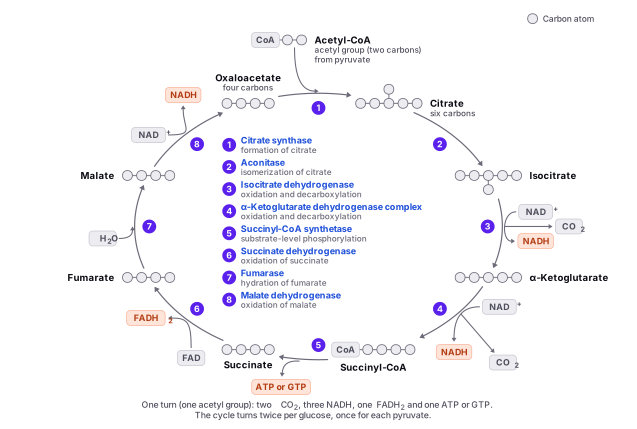
- Formation of citrate (irreversible): Acetyl-CoA, produced from one pyruvate molecule during the conversion of pyruvate to acetyl-CoA, combines with oxaloacetate to form citrate. This reaction is catalyzed by the enzyme citrate synthase.
- Isomerization of citrate (reversible): Citrate is isomerized to form isocitrate by the enzyme aconitase. This step involves the reversible interconversion of citrate and isocitrate through the intermediate cis-aconitate.
- Oxidation and decarboxylation of isocitrate (reversible): Isocitrate is oxidized and decarboxylated by the enzyme isocitrate dehydrogenase, generating alpha-ketoglutarate, NADH (from NAD+), and releasing a molecule of CO2.
- Oxidation and decarboxylation of alpha-ketoglutarate (irreversible): Alpha-ketoglutarate undergoes oxidation and decarboxylation by the alpha-ketoglutarate dehydrogenase complex, forming succinyl-CoA, NADH (from NAD+), and releasing another molecule of CO2.
- Conversion of succinyl-CoA to succinate (reversible): Succinyl-CoA is converted into succinate by the enzyme succinyl-CoA synthetase, producing one molecule of ATP (or GTP in some organisms) through substrate-level phosphorylation.
- Oxidation of succinate (reversible): Succinate is oxidized to form fumarate by the enzyme succinate dehydrogenase. This step generates one FADH2 molecule by reducing FAD to FADH2.
- Hydration of fumarate (reversible): Fumarate is converted to malate by the enzyme fumarase through the addition of a water molecule.
- Oxidation of malate (reversible): Malate is oxidized to form oxaloacetate by the enzyme malate dehydrogenase, generating one NADH molecule (from NAD+).
Find it in the figure
Coming soon for figure 5.10
After the completion of the Krebs cycle, the products include (per pyruvate molecule):
- 3 NADH molecules
- 1 FADH2 molecule
- 1 ATP or GTP molecule
- 2 CO2 molecules (released)
Since one glucose molecule produces two pyruvate molecules, the cycle occurs twice for each glucose molecule. Thus, the total products for one glucose molecule are:
- 6 NADH molecules
- 2 FADH2 molecules
- 2 ATP or GTP molecules
- 4 CO2 molecules (released)
The NADH and FADH2 molecules produced during the Krebs cycle, as well as those generated during glycolysis and the conversion of pyruvate to acetyl-CoA, are used in the electron transport chain (ETC) and oxidative phosphorylation to produce additional ATP molecules. The ETC and oxidative phosphorylation take place in the inner mitochondrial membrane, where a series
Let us then summarize what you have read for better consolidation. During the Krebs cycle, the breakdown of one glucose molecule through glycolysis produces two molecules of acetyl-CoA, which are the starting point for the Krebs cycle. For one cycle (one pyruvate), two molecules of carbon, three molecules of NADH, one molecule of FADH2, and one molecule of ATP or GTP are produced. The cycle occurs twice for each glucose molecule. In total, two Krebs cycles can produce a maximum of six NADH molecules and two FADH2 molecules.
It's important to note that the Krebs cycle is just one part of the process of cellular respiration. In addition to the Krebs cycle, cellular respiration also involves glycolysis, the electron transport chain, and oxidative phosphorylation. Together, these processes allow cells to produce energy from nutrients like glucose.
NADH and FADH2 are important coenzymes that are involved in the production of ATP through oxidative phosphorylation. They are produced during the Krebs cycle and other parts of cellular respiration, and they play a vital role in the generation of energy for cells.
Section 5.12
The Electron Transport Chain
The electron transport chain (ETC) is a critical component of cellular metabolism that plays an essential role in producing ATP, the primary energy source for cells. The ETC works in concert with other biochemical pathways, such as glycolysis and the Krebs cycle, to generate energy for cellular processes.
Glycolysis breaks down glucose into pyruvate, which is then converted into acetyl-CoA and fed into the Krebs cycle. The Krebs cycle generates NADH and FADH2, which provide electrons for the ETC. The ETC then uses these electrons to pump protons across the mitochondrial membrane, creating a proton gradient that drives the production of ATP through a process called oxidative phosphorylation.
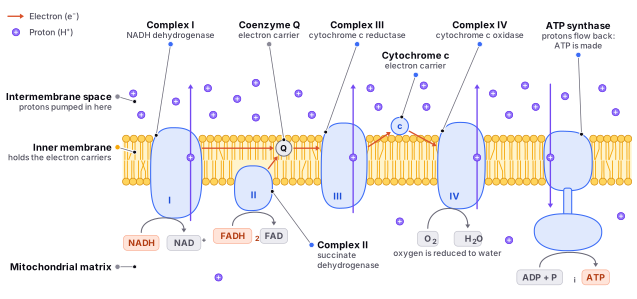
The electron transport chain (ETC) occurs in the inner membrane of the mitochondria. The ETC is a series of protein complexes and electron carriers that are responsible for the production of ATP, the energy currency of cells. The four protein complexes in the ETC are vital for the transport of electrons and the establishment of the proton gradient. These four are: Complex I (NADH dehydrogenase), Complex II (succinate dehydrogenase), Complex III (cytochrome c reductase), and Complex IV (cytochrome c oxidase). Electron carriers, such as coenzyme Q and cytochrome c, transfer electrons between the protein complexes. Each complex plays a unique role in the transport of electrons from NADH and FADH2 to molecular oxygen, the final electron acceptor. As electrons flow through the ETC, energy is released, which is used to pump protons across the mitochondrial membrane, ultimately leading to the generation of ATP.
As the electrons move through the electron transport chain, they give off energy. This energy is used to pump protons across a special membrane in the mitochondria. This creates a difference in the concentration of protons on either side of the membrane, which is called a proton gradient.
The proton gradient is like a hill of water. If you let the water flow down the hill, it will generate energy as it goes. The same is true for the protons in the electron transport chain. When they flow down the proton gradient, they generate energy that is used to produce ATP, the energy currency of the cell.
In addition to producing ATP, the ETC also plays a critical role in regulating cellular metabolism. The rate of electron transport through the ETC is tightly regulated by feedback mechanisms, ensuring that ATP production is appropriately matched to the energy needs of the cell. This regulation is essential for maintaining cellular homeostasis and preventing cellular damage that can result from excessive ATP production.
In summary, the electron transport chain is a vital component of cellular metabolism that allows cells to produce ATP, the primary energy source for cellular processes. It works in concert with other biochemical pathways, such as glycolysis and the Krebs cycle, to generate energy from nutrients like glucose. The tight regulation of the ETC is essential for maintaining cellular homeostasis and preventing cellular damage from excessive ATP production.
Find it in the figure
Coming soon for figure 5.11
The Components of The ETC
The electron transport chain (ETC) is like a relay race, with each protein complex passing the baton (in this case, electrons) to the next. The electron transport chain involves several specific proteins, here are some examples:
NADH dehydrogenase: This protein accepts electrons from NADH, a coenzyme that is produced during the Krebs cycle. NADH dehydrogenase is like the starting runner, accepting the electrons (the baton) from the Krebs cycle (the previous runner) and passing them on to the next complex.
Cytochrome c: This protein carries electrons from one part of the electron transport chain to another. Cytochrome c is like the middle runner, carrying the electrons (the baton) from one part of the ETC (the track) to another. It's like a baton carrier running around the track to hand off the baton to the next runner.
Cytochrome c oxidase: This protein accepts electrons from cytochrome c and uses them to pump protons across the membrane. Cytochrome c oxidase is like the final runner, receiving the electrons (the baton) from cytochrome c and using them to pump protons across the membrane. This is like the final runner pushing hard to cross the finish line and win the race.
ATP synthase: This protein uses the energy generated by the flow of protons down the proton gradient to produce ATP. ATP synthase is like the coach waiting at the finish line, using the energy generated by the flow of protons down the proton gradient to produce ATP.
Together, these proteins work together to generate ATP, which is used by cells to power their activities. The electron transport chain is an essential part of cellular respiration and is involved in the production of the majority of ATP in the body.
Section 5.13
Oxidative Phosphorylation
Oxidative phosphorylation is a process that occurs in the mitochondria of cells. It is an integral part of cellular respiration, the process by which cells produce energy from nutrients.
Oxidative phosphorylation is like a machine that converts the energy stored in the electrochemical gradient into energy that is available to turn ADP+Pi back into ATP. It does this by using the kinetic energy and the movement of protons through a unique structure called ATP Synthase, while the protons flow back through it, the movement is converted into enough energy to “charge the battery (from our previous analogy).
ATP Synthase
ATP Synthase is like a hydroelectric dam. Just as a dam uses the energy of falling water to generate electricity, ATP synthase uses the energy of flowing protons to produce ATP, the energy currency of the cell.
The energy for ATP synthase comes from the movement of protons across a special membrane in the mitochondria. This movement of protons creates a difference in the concentration of protons on either side of the membrane, causing a “proton gradient”. The proton gradient is like a hill of water, and when the protons flow down the hill, they generate energy.
ATP synthase captures this energy and uses it to produce ATP. It does this by using a special mechanism that rotates like a turbine as the protons flow through it. The rotation of the turbine drives the synthesis of ATP from adenosine diphosphate (ADP) and inorganic phosphate (Pi).
In summary, ATP synthase is an important part of cellular respiration because it allows cells to produce energy from nutrients like glucose. It's like a machine that converts the energy stored in nutrients into a form that cells can use to power their activities.
Section 5.14
Summary of the Yields of the Different Biochemical Pathways
Here is a summary of the yields for glycolysis, Krebs cycle, electron transport chain, and oxidative phosphorylation per 1 glucose molecule:
Glycolysis:
- 2 pyruvate molecules
- 2 NADH molecules
- 4 ATP molecules (gross yield); 2 ATP molecules (net yield, as 2 ATP are used during the energy-investment stage)
Krebs Cycle (2 cycles per glucose molecule):
- 6 NADH molecules
- 2 FADH2 molecules
- 2 ATP or GTP molecules
- 4 CO2 molecules (released)
Electron Transport Chain and Oxidative Phosphorylation (estimations based on P/O ratios):
- 10 NADH molecules in total (2 from glycolysis, 2 from pyruvate decarboxylation, 6 from Krebs cycle) producing 25 ATP molecules (2.5 ATP per NADH)
- 2 FADH2 molecules in total (from Krebs cycle) producing 3 ATP molecules (1.5 ATP per FADH2)
- 28-32 ATP molecules in total (the exact number may vary depending on the efficiency of the process and shuttle systems for NADH produced in glycolysis)
In summary, one glucose molecule yields approximately 36-38 ATP molecules through glycolysis, the Krebs cycle, and the electron transport chain combined with oxidative phosphorylation. The exact number can vary depending on specific cellular conditions and the efficiency of the processes involved.